


Smart Agriculture Solution Market Heads Toward USD 34.6 Billion by 2036 with Automation Reshaping Farm Operations | Trimble, Topcon Positioning Systems, CNH Industrial
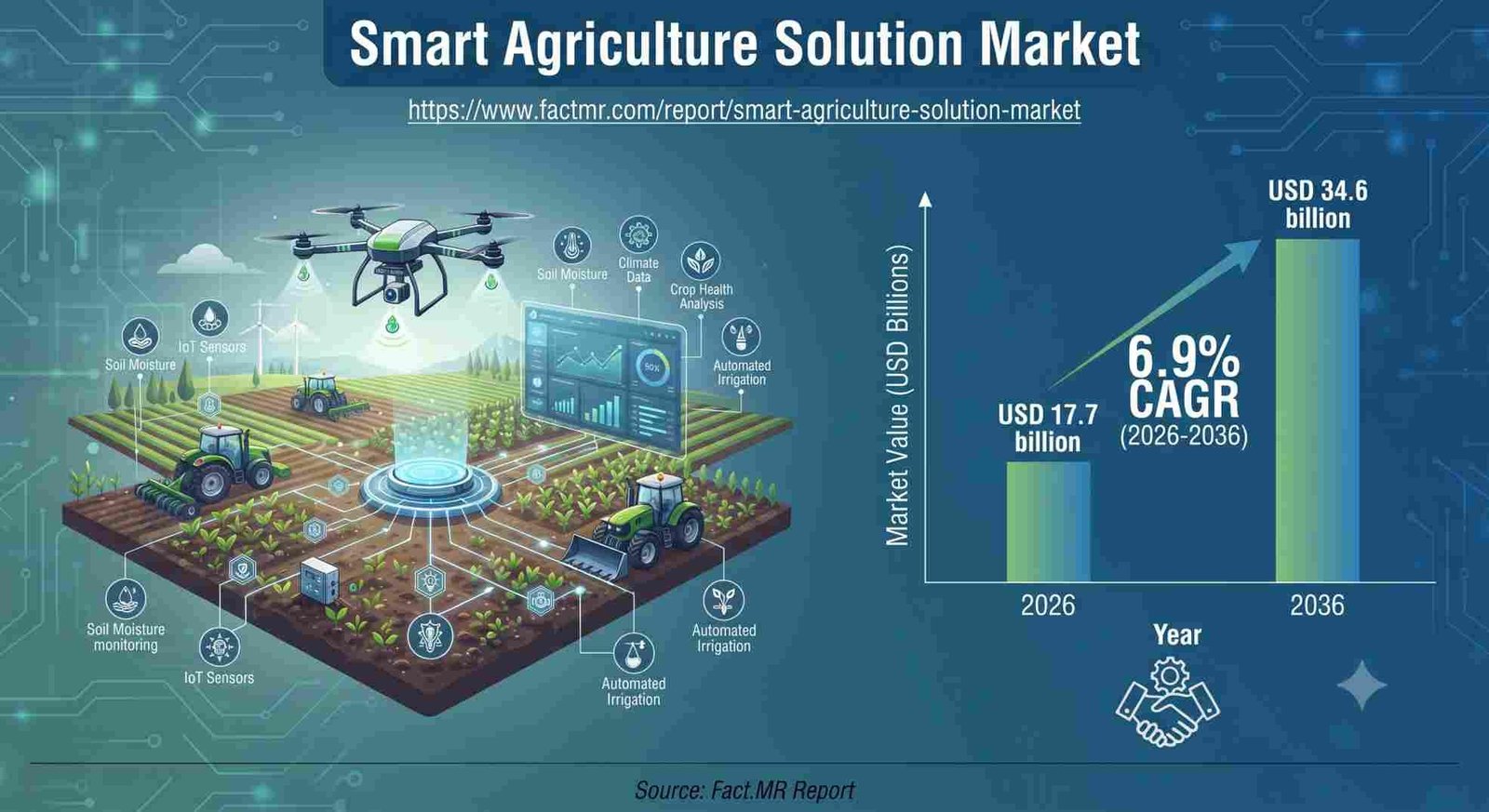
The global smart agriculture solution market is projected to reach USD 34.6 billion by 2036, rising from USD 17.7 billion in 2026 at a 6.9% CAGR, according to Fact.MR. The market was valued at USD 16.6 billion in 2025 and is expanding as farmers adopt digital systems for crop monitoring, resource management, automated machinery control, and agricultural data analysis.
The market is expected to add approximately USD 16.9 billion between 2026 and 2036. Growth reflects the gradual integration of precision farming systems, connected farm equipment, sensor networks, drones, GPS-enabled machinery, and digital farm management platforms into commercial agricultural operations.
Get Detailed Market Forecasts, Competitive Benchmarking, And Pricing Trends: https://www.factmr.com/connectus/sample?flag=S&rep_id=14606
Smart Agriculture Solution Market Growth Follows Digital Farm Adoption
Smart agriculture solutions combine sensors, connected devices, data analytics platforms, automated equipment, and digital farm management systems to monitor and optimize agricultural operations.
These technologies collect information on soil moisture, crop conditions, weather patterns, equipment performance, and field productivity. Farmers use this information to support irrigation, fertilization, crop protection, and machinery decisions.
The market is growing as agricultural producers seek better productivity and tighter control over input costs. However, high initial equipment costs, fragmented farm structures, and uneven digital infrastructure across rural areas continue to moderate adoption.
Hardware Components Account for 45% Share
The hardware segment represents approximately 45% of the smart agriculture solution market, according to Fact.MR. Hardware forms the operational base for connected farming systems and includes sensors, drones, GPS-enabled ranging systems, and smart detection equipment.
Sensors collect real-time information on soil and crop conditions. Drones support field monitoring and aerial data collection, while GPS-enabled equipment provides positioning information for precision agricultural operations.
The deployment of connected agricultural equipment across large cultivation areas is supporting demand for hardware-based smart agriculture solutions.
Automated Machinery Guidance Holds 30% Share
The automated machinery guidance control application accounts for approximately 30% market share, according to Fact.MR.
These systems use GPS and sensor technologies to guide tractors, harvesters, and other agricultural machinery during field operations. Accurate guidance can help maintain planting rows, improve field coverage, and reduce overlaps during fertilizer application and crop spraying.
Large-scale farming operations are an important application area because automated guidance systems can support machinery movement across extensive cultivation areas while reducing unnecessary resource use.
Precision Farming Supports Market Expansion
Precision farming remains a major demand driver as agricultural producers deploy sensor networks, GPS-guided machinery, and drone monitoring systems.
Digital farm management platforms combine field data with analytical tools to support decisions related to irrigation, fertilization, and crop protection. Automated machinery systems also support planting, irrigation, and harvesting activities.
The development of integrated platforms is creating opportunities for companies that combine agricultural equipment with digital technologies.
South Korea Records 11.7% CAGR
South Korea is projected to record a 11.7% CAGR from 2026 to 2036, according to Fact.MR. Growth is supported by government programs promoting digital agriculture and automated farming systems.
The United States follows with a 11.5% CAGR, supported by large commercial farms adopting precision agriculture platforms and connected farm machinery.
The European Union is projected to grow at 11.4% CAGR, while the United Kingdom records 11.2% and Japan reaches 11.1% during the forecast period.
Japan's comparatively mature agricultural technology market means further adoption is increasingly connected to equipment replacement cycles. High equipment costs and limited rural digital connectivity remain constraints across established markets.
USA Smart Agriculture Adoption Expands Through Precision Farming
Demand for smart agriculture solutions in the United States is projected to rise at a 11.5% CAGR through 2036.
Fact.MR identifies precision agriculture initiatives promoted by the United States Department of Agriculture in April 2025 as a supporting factor. Expansion of digital farming platforms by John Deere in August 2025 also contributes to the country's technology adoption.
The United States has large commercial farming operations where GPS-enabled machinery, farm management software, sensors, and automated systems can be deployed across extensive cultivation areas.
European Union and UK Increase Digital Farm Deployment
Demand for smart agriculture solutions in the European Union is projected to grow at 11.4% CAGR through 2036. Growth is supported by digital agriculture programs under the European Commission's Common Agricultural Policy in April 2025 and agricultural technology platform expansion by AGCO Corporation in August 2025.
The United Kingdom is projected to grow at 11.2% CAGR. Agricultural innovation programs promoted by the Department for Environment, Food and Rural Affairs in March 2025, alongside farm management software deployment by Trimble Inc. in July 2025, support market development.
East Asia Advances Through Smart Farming Programs
Japan's smart agriculture solution market is projected to expand at a 11.1% CAGR through 2036. Smart farming initiatives promoted by the Ministry of Agriculture, Forestry and Fisheries in March 2025 and agricultural automation systems developed by Kubota Corporation in July 2025 support technology deployment.
South Korea records the highest country growth among the markets highlighted, at 11.7% CAGR. Smart farm expansion programs promoted by the Ministry of Agriculture, Food and Rural Affairs in February 2025 and agricultural IoT platform deployment by LG CNS in June 2025 are identified as supporting developments.
Market Challenges and Strategic Priorities
High equipment costs remain a constraint for agricultural technology adoption. Smaller and fragmented farms can face greater difficulty allocating capital for integrated digital farming systems.
Limited digital connectivity across rural farming areas also affects deployment. Advanced platforms can require technical expertise and higher upfront investment, restricting adoption where digital infrastructure remains limited.
Agricultural data governance is another consideration. Government programs and agricultural data initiatives regulate the collection and sharing of farm-generated digital information in several markets.
For technology providers, integrated solutions combining sensors, GPS-enabled machinery, farm management software, and automated monitoring can address multiple agricultural requirements through connected platforms.
Competitive Landscape Focuses on Integrated Farm Technology
The competitive landscape includes Deere & Company, Trimble Inc., AGCO Corporation, Raven Industries, Inc., Topcon Positioning Systems, Inc., CNH Industrial N.V., BASF SE, The Climate Corporation, Yara International ASA, and Sentera, Inc.
Deere & Company, AGCO Corporation, CNH Industrial N.V., and Trimble Inc. maintain positions through precision farming systems that connect agricultural machinery, sensors, and digital farm management platforms.
Raven Industries, Inc., Topcon Positioning Systems, Inc., and Sentera, Inc. contribute satellite guidance, field monitoring, and aerial imaging technologies.
BASF SE, The Climate Corporation, and Yara International ASA participate through agronomic data platforms and crop management analytics.
Competition is influenced by data accuracy, integration with existing farm machinery, technical support, and the ability of digital systems to support farm productivity.
Analyst Perspective
Shambhu Nath Jha, Principal Consultant, Fact MR, said, "In this updated edition of the Smart Agriculture Solution Market report, industry participants will observe that digital technologies are gradually integrated into farming operations to support precision agriculture practices."
Jha added that sensor networks, automated machinery systems, and farm management software allow producers to monitor field conditions and optimize resource usage. Companies combining agricultural equipment with integrated digital platforms are positioned to maintain stronger positions within the evolving agricultural technology ecosystem.
Top Trending Reports:
https://www.openpr.com/news/4597921/digital-cold-chain-management-market-revenue-set-to-increase
https://www.openpr.com/news/4597937/electric-vehicle-battery-testing-equipment-market-valued-at-usd
https://www.openpr.com/news/4597946/e-commerce-returns-and-reverse-logistics-packaging-market
https://www.openpr.com/news/4599289/zonal-heat-pump-cabin-hvac-market-valued-usd-2-5-billion-in-2026
About Fact.MR
Fact.MR provides market research and industry analysis covering market size, segmentation, growth forecasts, competitive developments, regional trends, and strategic opportunities. Its research methodology incorporates primary research with agricultural technology providers, farm operators, agronomists, agricultural equipment distributors, and other industry participants, alongside desk research covering agricultural statistics databases, industry publications, company reports, and government agriculture departments.

 English
 Romaian
 Greek
Greek