


Telecom Network Infrastructure Market Expands With Next-Generation Networks
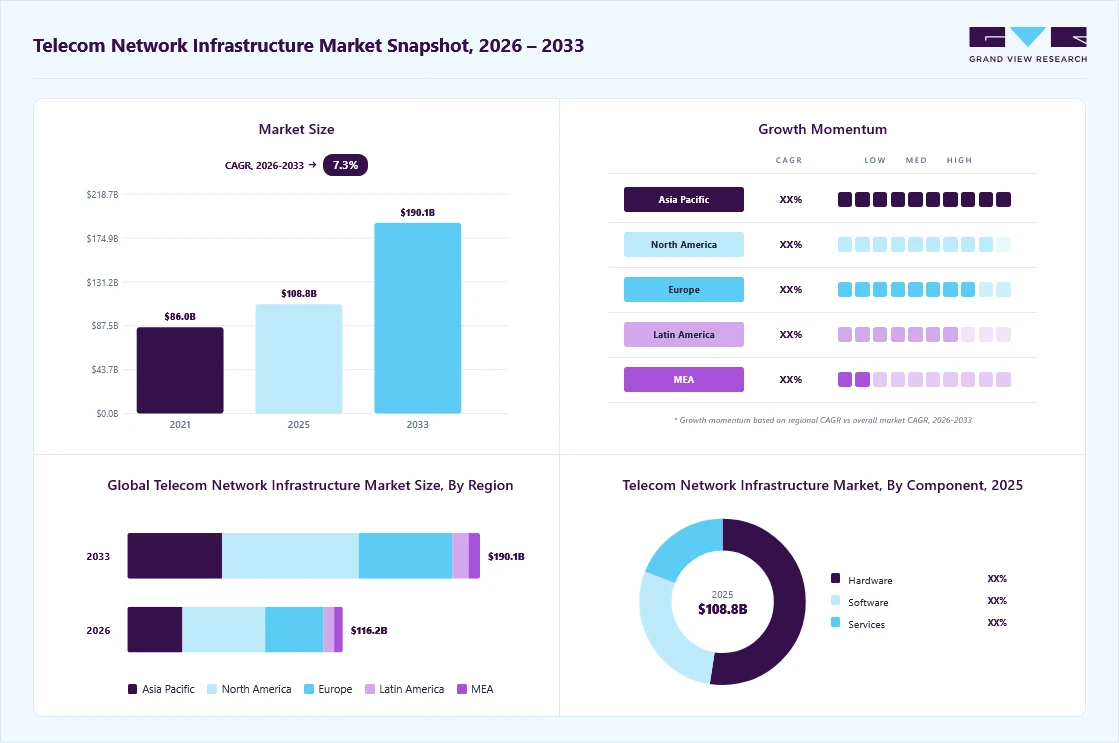
The market was valued at USD 108.8 billion in 2025 and is projected to grow from USD 116.2 billion in 2026 to USD 190.1 billion by 2033, advancing at a 7.3% CAGR from 2026 to 2033. North America held the largest revenue share of 38.4% in 2025, while Asia Pacific is expected to register the fastest CAGR during the forecast period.
Market Segmentation (2026 Landscape)
The telecom network infrastructure market spans wireless network infrastructure, fixed network infrastructure, core network infrastructure, and transport network infrastructure. Wireless network infrastructure led the market with a 45.5% revenue share in 2025 and is also expected to grow at the fastest CAGR during the forecast period. Rapid 5G deployment, rising mobile data consumption, small-cell expansion, and demand for seamless connectivity are supporting this position.
By component, hardware held the largest market share in 2025. Increasing investment in base stations, antennas, routers, switches, optical transport equipment, and other networking equipment is supporting hardware demand. At the same time, software is expected to grow at a significant CAGR as operators adopt software-defined networking, network functions virtualization, and AI-enabled analytics.
The 5G segment held the largest share by network technology in 2025. Its growth is being supported by investments in next-generation mobile networks, Massive MIMO, advanced spectrum management, and applications requiring low latency and high bandwidth. Satellite infrastructure is expected to register a notable CAGR from 2026 to 2033 as demand for broadband and connectivity in remote areas increases.
By end user, telecom operators held the largest share in 2025. Data centers are expected to register a notable CAGR during the forecast period, supported by cloud computing, enterprise IT services, AI-powered applications, edge computing, hyperscale facilities, and colocation services.
Primary Growth Drivers in 2026
The continued rollout of 5G is one of the most significant growth catalysts. Higher data speeds, lower latency, and improved reliability are encouraging operators to upgrade radio access, core, and transport networks. The increasing use of connected devices and data-intensive applications is simultaneously raising bandwidth requirements.
Data consumption is another major contributor. In India, mobile data traffic reached 17.4 exabytes per month in 2023, while average monthly data consumption per user reached 24.1 GB. Ericsson projects that per-smartphone monthly data use will rise from 29 GB in 2023 to 68 GB by 2029.
Cloud computing, remote work, IoT, AI, and immersive technologies are creating additional pressure for high-speed and reliable networks. Data centers require robust fiber, core, and transport infrastructure to process and distribute growing volumes of information.
Smart-city development is also opening new opportunities. Connected traffic systems, environmental sensors, smart infrastructure, IoT applications, and AI analytics require dense 5G networks, edge computing, and fiber broadband.
Key Technology Trends
Network virtualization and automation are changing how telecom infrastructure is designed and operated. Software-defined networking and network functions virtualization enable operators to dynamically allocate resources, optimize traffic, and improve network flexibility while reducing operational costs.
AI is increasingly becoming part of network management and infrastructure development. AI-enabled analytics can improve performance monitoring, fault detection, maintenance, and resource optimization. Edge computing is similarly becoming important because it enables data processing closer to users and connected devices, supporting latency-sensitive applications.
The market is also moving toward AI-native telecom infrastructure. In October 2025, NVIDIA partnered with Nokia to develop an AI-RAN platform and invest USD 1 billion to advance AI-native 5G-Advanced and 6G networks. The collaboration is intended to integrate AI computing into radio access networks and support edge AI inferencing.
Satellite connectivity is another emerging technology avenue. GEO, MEO, and LEO satellite infrastructure can extend broadband, IoT, maritime, aviation, and disaster-recovery connectivity to locations where terrestrial infrastructure is limited.
Regional Outlook
North America dominated the market with a 38.4% share in 2025. Large investments in 5G, broadband, wireless, core, and transport infrastructure are supporting its leadership. Government programs and spectrum initiatives are also encouraging network expansion, particularly in underserved areas.
Asia Pacific is expected to grow at the fastest CAGR during the forecast period. Rapid 5G deployment, fiber expansion, rising mobile connectivity, network modernization, and growing data consumption are driving investment. India provides a strong example of this expansion, with total internet subscribers reaching 979 million by June 2025.
Europe is experiencing continued investment in 5G and fiber-optic broadband, supported by government funding and operator capital expenditure. Latin America is also seeing infrastructure expansion, including Nokia's October 2025 partnership with Ecuador's Corporación Nacional de Telecomunicaciones to launch the country's first commercial 5G network with 188 sites.
FAQs
What is driving telecom network infrastructure market growth?
Growth is being driven by surging 5G deployment, rising demand for high-speed data and seamless connectivity, cloud services, data-center expansion, IoT adoption, AI applications, edge computing, and advances in network virtualization and automation.
Which segment leads the telecom network infrastructure market?
Wireless network infrastructure led the infrastructure type segment with a 45.5% revenue share in 2025. Hardware held the largest component share, 5G held the largest network technology share, and telecom operators held the largest end-user share in 2025.
Key Telecom Network Infrastructure Companies:
· Huawei Technologies Co., Ltd.
· Nokia Corporation
· Telefonaktiebolaget LM Ericsson (publ)
· ZTE Corporation
About us:
Grand View Research, a market research and consulting company, provides syndicated research reports, customized research reports, and consulting services. Grand View Research database is used by the world's renowned academic institutions and Fortune 500 companies to understand the global and regional business environment. Our database features thousands of statistics and in-depth analysis on 46 industries in 25 major countries worldwide.

 Romaian
 Portuguese (Brazil)
 Greek
Greek